 DogsLife
Free tool
Puppy sleep calculator
Puppies sleep far more than most new owners expect. Enter your puppy's age and your household's night to see the typical total sleep for its age, roughly how much has to happen as daytime naps, and what the nap pattern usually looks like.
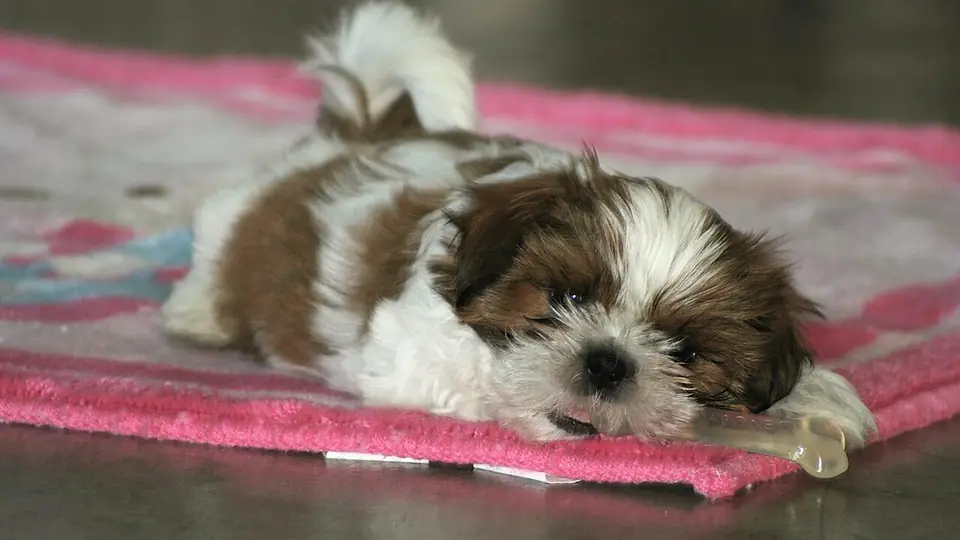
Puppies sleep a lot: about 18–20 hours a day at 8–16 weeks, 16–18 hours at 4–6 months and 14–16 hours at 6–12 months, as night sleep plus naps through the day.
How the numbers are worked out
The calculator puts your puppy into one of four age bands and shows the sleep range published for that band:
| Age | Typical total sleep per 24 h | Source |
|---|---|---|
| 8–16 weeks | 18–20 hours | Agria; the AKC and a Zoetis vet give the same range for young puppies |
| 4–6 months | 16–18 hours | Agria |
| 6–12 months | 14–16 hours | Agria |
| 1 year and older | 12–14 hours | Zoetis Petcare; Hill's (citing the AKC) |
It then takes your night (bedtime to wake-up) away from the total. What is left is roughly how much sleep has to come as daytime naps. For a 10-week-old puppy with a 22:00 to 07:00 night, that is 9 hours at night and 9–11 hours of naps during the 15 hours you are up.
The nap pattern for young puppies comes from the American Kennel Club: a nap about every hour, lasting anywhere from 30 minutes to two hours. The note about sleeping through the night comes from Zoetis Petcare.
Why the numbers vary so much
Published figures differ. A large University of Bristol study (Generation Pup) asked owners how long their dogs slept, and the reported totals were well below the guideline figures: around 11 hours at 16 weeks. Those figures are owners' estimates rather than measurements, which is one reason sources disagree. The study did confirm the direction of change: 16-week-olds slept more in the day and in total, and 12-month-olds slept more at night.
So treat the range as typical, not as a target. What matters more is the trend for your own puppy, and whether it gets a real chance to rest between bursts of activity.
Helping your puppy get enough sleep
- Plan quiet time after activity. After a walk, play or a training session, give your puppy a calm spot to settle.
- Give it a sleeping place of its own. It should be quiet, out of the busiest part of the home, where children know not to disturb it.
- Watch for overtiredness. Biting, zoomies and whining in the evening are often a sign of too little sleep. Our guide to the overtired puppy covers what to do.
- Keep nights boring. Night potty trips should be quick and quiet, with no play, so going back to sleep is easy. See the guide to the first night home.
When to ask your vet
Ask your vet if your puppy is hard to wake, seems weak or wobbly, stops eating or drinking, or if its sleep suddenly changes a lot without an obvious reason (a busy day, a new home, a vaccination). Older dogs' sleep changes too; see senior dog sleep changes.
Let DogsLife learn your puppy's real rhythm
Typical ranges tell you what is common. DogsLife tells you what is normal for your puppy. Log naps and nights with a tap and the app builds your puppy's real sleep pattern, shows total sleep per day and suggests when the next nap is due.
Frequently asked questions
How many hours a day should an 8-week-old puppy sleep?
Usually about 18–20 hours per 24 hours, according to the American Kennel Club, a Zoetis vet and Agria. Most of that comes as many short naps, not one long sleep.
Is my puppy sleeping too much?
A lot of sleep is normal for a growing puppy. Sleeping a lot is a concern when it comes with other changes: not eating, being hard to wake, weakness, vomiting or diarrhoea. In that case call your vet.
Should I wake my puppy up from naps?
Generally no. The AKC advises leaving a sleeping puppy undisturbed. The exception is a potty trip: when it wakes on its own, take it straight out. See the potty schedule calculator.
When do puppies sleep through the night?
Many manage a full night somewhere around 16–20 weeks, according to a Zoetis vet, and VCA notes some may still need a night trip until about 5 months. Every puppy is different.
Why does my puppy go wild in the evening?
Often it is overtired, not under-exercised. A quiet spot and a chance to sleep usually works better than more play. Our guide to the overtired puppy explains the signs.
Sources
- How to make sure your puppy gets enough sleep — American Kennel Club
- Puppy sleep: what to expect — Zoetis Petcare (Melody R. Conklin, VMD)
- How much should my dog sleep per day? — Hill's Pet Nutrition (reviewed by Hill's veterinary experts)
- Valpars sömnbehov (Puppies' sleep needs, in Swedish) — Agria Djurförsäkring
- Sleep duration and behaviours: a descriptive analysis of a cohort of dogs up to 12 months of age (Kinsman et al., Animals 2020) — University of Bristol
- Housetraining for puppies and dogs — VCA Animal Hospitals